

Why Getting Started Right Matters More Than Your First Gun Choice
First-time gun owner tips can make the difference between developing safe, confident habits and creating dangerous patterns that stick for life. With over 4.2 million first-time gun owners in 2022 and 4.3 million in 2023, we’re seeing historic numbers of new owners entering the firearms community.
Essential First-Time Gun Owner Tips:
- Master the Four Rules – Treat every gun as loaded, never point at anything you don’t want to destroy, finger off trigger until ready to shoot, know what’s beyond your target
- Get Legal First – Complete ATF Form 4473, pass NICS background check, obtain required state/local permits
- Try Before You Buy – Rent different firearms at ranges to test fit, recoil, and handling
- Invest in Training – Professional instruction prevents accidents and builds proper technique
- Secure Storage – Gun safe or quality lock prevents unauthorized access and theft
- Practice Regularly – Monthly range visits with 50-100 rounds maintain proficiency
Budget Reality Check: Plan $350+ for basic rifles/shotguns, $600+ for pistols, plus accessories, training, and ongoing ammo costs.
As someone who’s managed gun stores in Albuquerque since 2015 and witnessed both successful self-defense situations and preventable accidents during my paramedic/firefighter career, I’ve seen how proper first-time gun owner tips literally save lives.
Safety First – The Four Rules You’ll Live By
Every single accidental shooting could have been prevented by following these four fundamental rules. They’re not suggestions – they’re the non-negotiable foundation that keeps you and everyone around you safe.
Rule 1: Treat Every Gun as Loaded
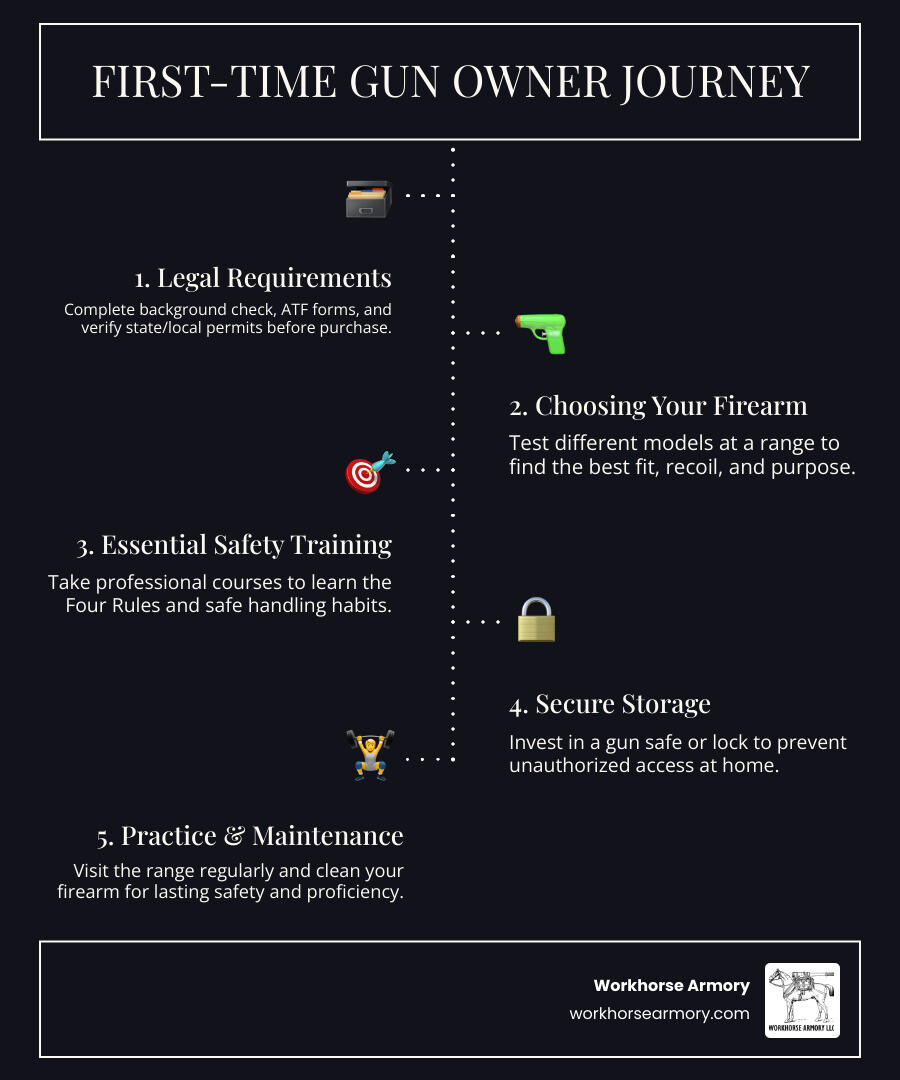
Even when you’re certain a firearm is empty, act like it’s loaded. Remove the magazine, lock the slide back, and visually inspect the chamber. Competition shooters make this a habit – they’ll drop the hammer on an empty chamber to confirm it’s cold before doing anything else.
Rule 2: Never Point the Muzzle at Anything You Don’t Want to Destroy
This is called muzzle discipline. Your brain needs to constantly track where that barrel is pointing. Keep it pointed downrange at the range, toward the ground elsewhere. Never let it sweep across your body or anyone else’s.
Rule 3: Keep Your Finger Off the Trigger Until Ready to Shoot
Your finger belongs on the frame, not in the trigger guard, until you’ve made the conscious decision to fire. This trigger control habit prevents accidental discharges during loading, unloading, or when startled.
Rule 4: Be Sure of Your Target and What’s Beyond It
Bullets don’t stop at your target – they can travel over a mile beyond where you’re aiming. Before you pull that trigger, identify your target clearly and think about what’s behind it.
Building Safe Habits
Smart first-time gun owner tips include using dummy rounds for practice and chamber flags for visual confirmation your gun is empty. Dry-fire practice at home builds muscle memory safely, but always double-check that your gun is completely unloaded first.
More info about safe handling services
Hot vs. Cold Range Commands
Understanding range etiquette makes the difference between a safe experience and a dangerous situation. A “hot” range means firearms are loaded and ready to shoot. A “cold” range means all firearms must be unloaded with actions open.
The most important command is “cease fire.” When someone calls this, stop shooting immediately, keep your gun pointed downrange, and wait for instructions. When someone needs to go downrange, the range officer calls “cease fire,” then “range is cold.” All guns get unloaded with chambers open and actions locked back.
First-Time Gun Owner Tips: Handling Jams & Misfires
Malfunctions happen to everyone. The key is staying calm and keeping that muzzle pointed in a safe direction. For a stovepipe jam – where an empty case gets stuck in the ejection port – keep the gun pointed downrange, lock the slide back, remove the stuck case by hand, then let the slide go forward.
For a failure to fire, keep the gun pointed downrange for at least 30 seconds – that cartridge might be a “hang fire” that could still ignite. After waiting, carefully eject the unfired round.
Use quality ammo from reputable manufacturers and always wear proper eye and ear protection when shooting.
Clearing the Legal Problems Before You Buy
Gun laws are like a patchwork quilt where every state has its own pattern. First-time gun owner tips always start with understanding the legal maze before you buy.
Federal law is your baseline everywhere. Every purchase from a licensed dealer means filling out ATF Form 4473 and passing the NICS background check. You’ll need to be 18 for rifles and shotguns, or 21 for handguns. The government maintains a list of prohibited persons who can’t legally own firearms.
State laws vary dramatically. As of January 2024, we’ve got 27 states allowing permitless concealed carry, while 23 states plus D.C. operate under shall-issue systems. Eight states plus D.C. require safety training before purchase. Some states add waiting periods, magazine limits, or restrictions on certain firearms.
Local ordinances can surprise you. Your city or county might have additional rules about storage, transport, or carrying that differ from state law.
The prohibited persons list includes people with felony convictions, domestic violence restraining orders, certain mental health adjudications, illegal drug use, and other disqualifying factors. The golden rule is honesty – lying on Form 4473 is a federal felony.
Scientific research on firearm regulations
Documentation & Background Checks Explained
Your government-issued photo ID is non-negotiable. A driver’s license or state ID card works perfectly. Make sure it’s current and matches your legal name exactly.
Proof of current residence comes next. A utility bill, lease agreement, or bank statement from the last 90 days usually works. State-required permits or certificates vary depending on where you live.
The NICS process happens behind the scenes while you’re filling out paperwork. Most checks come back within minutes, but the system has up to three business days. You’ll get “Proceed,” “Denied,” or “Delayed.” If no decision comes back within three business days, the dealer can proceed with the sale under “default proceed.”
Transporting Firearms Legally
Air travel requires following TSA’s specific rules. Firearms must be unloaded and locked in hard-sided cases. You’ll declare them to the airline at check-in. Ammunition needs to be in original packaging or proper containers.
Vehicle transport varies by state, but most require firearms to be unloaded and cased. The universal rule is never leave firearms visible in vehicles – it’s an invitation for theft.
Interstate travel gets complicated fast. The federal Firearm Owners Protection Act provides some protection when traveling between states where you can legally possess firearms, but you still need to comply with laws in each state you pass through.
| State | Unloaded Required | Cased Required | Separate Ammo | Permit Override |
|---|---|---|---|---|
| New Mexico | No* | No* | No* | Yes |
| Texas | No* | No* | No* | Yes |
| Colorado | Yes | Yes | No | Limited |
| California | Yes | Yes | Yes | No |
| Arizona | No* | No* | No* | Yes |
*With valid concealed carry permit
The safest approach for new owners is to transport firearms unloaded, in a locked case, with ammunition stored separately.
Picking the Right Tool & Essential Gear
Choosing your first firearm isn’t about what looks coolest – it needs to match what you actually plan to do with it.
For self-defense, you have three solid options. Handguns give you maneuverability and concealed carry options but demand more training. Shotguns deliver devastating close-range effectiveness with less risk of over-penetration. Rifles offer the best accuracy and stopping power but are tougher to handle in tight spaces.
For recreational shooting, a .22 LR rifle makes an excellent first firearm – minimal recoil, cheap ammunition, and you’ll master fundamentals without developing a flinch. For handguns, 9mm pistols hit the sweet spot of manageable recoil with widely available ammunition.
For hunting, match your caliber to your intended game and check local regulations for restrictions.
Recoil management should be your top priority as a new shooter. Start with milder calibers and work up as your skills grow. The gun needs to fit your hands properly – if you can’t reach the trigger comfortably, you’ll struggle with accuracy.
Stick with proven designs from reputable manufacturers and choose common calibers like 9mm, .223, or 12 gauge. You’ll find ammunition everywhere at reasonable prices.
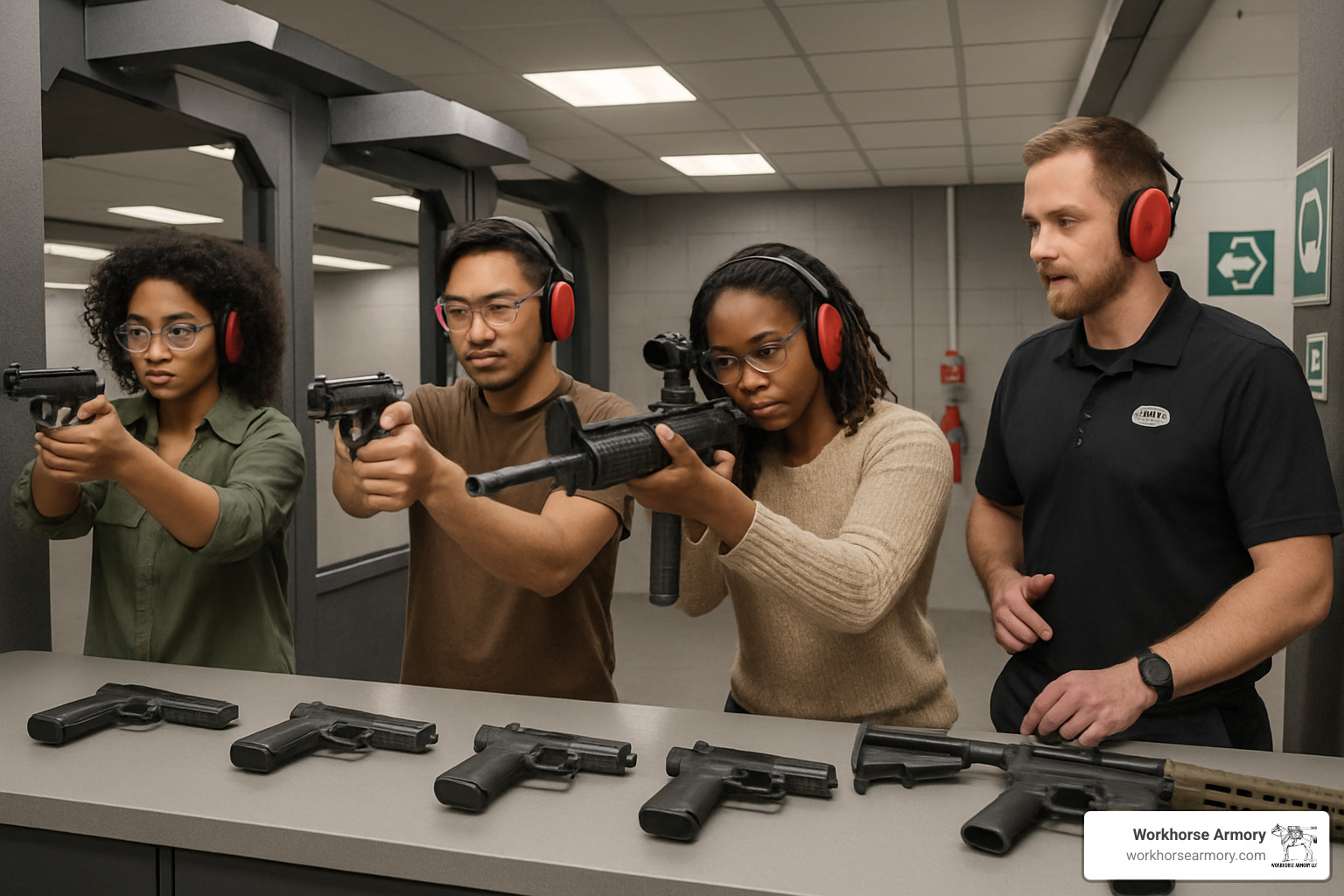
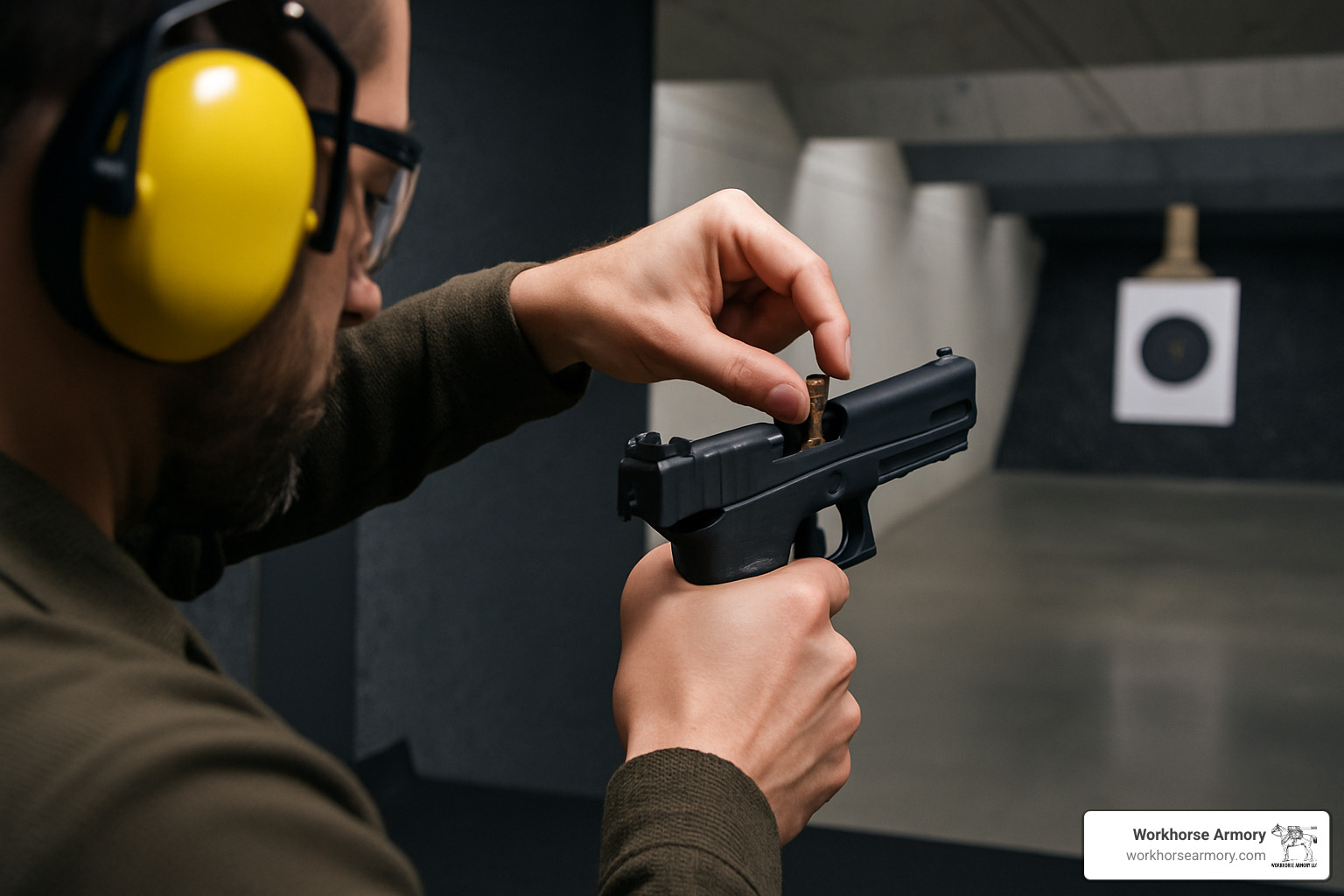
Try before you buy. Find a range that rents firearms and spend an afternoon testing different models. Pay attention to how each gun feels, how recoil affects your control, and whether you can see the sights clearly.
Must-Have Accessories Checklist
Security comes first. You need a gun safe or security cabinet – not just for legal compliance, but because unsecured firearms get stolen or cause accidents. Cable locks work as backup security.
Cleaning and maintenance keep your investment running reliably. A basic cleaning kit with bore brushes, patches, cleaning rods, gun oil, and cleaning solvent handles routine care.
For shooting, eye and ear protection aren’t optional. If you bought a semi-automatic, plan on at least three spare magazines. A quality range bag makes transporting everything easier.
For self-defense, add a weapon-mounted flashlight and quality holster that completely covers the trigger guard. Don’t forget a sturdy gun belt designed for carry.
Stock up on ammunition wisely – 500-1000 rounds of practice ammunition plus 50-100 rounds of premium defensive ammunition if protection is your goal.
First-Time Gun Owner Tips: Budgeting Smartly
The sticker price represents maybe half of your actual first-year costs. Basic shotguns and rifles start around $350-500, quality handguns run $600-900. Essential accessories add another $300-500. Factor in training at $100-300 and initial ammunition at $100-200. You’re looking at $850-1400 to get started properly.
Ongoing expenses include monthly range fees ($20-40), ammunition for each practice session ($25-50), annual training courses ($200-500), and maintenance supplies ($50-100 per year).
Make your money go further by buying ammunition in bulk when prices drop, joining shooting clubs for reduced range fees, and learning basic maintenance. Most importantly, start with one quality firearm rather than multiple cheap ones.
Practice, Training & Home Storage Master Plan
The most expensive gun won’t help if you can’t use it safely and effectively. Think of your firearm purchase as buying a musical instrument – the real work begins after you get it home.
Professional training should be your first investment. Look for NRA-certified or USCCA-certified instructors who can teach fundamentals properly from day one. They’ll cover safe handling, basic marksmanship, loading/unloading techniques, malfunction clearance, and legal responsibilities.
Plan to visit the range at least monthly, shooting 50-100 rounds per session. Focus on consistent grip and stance first, then work on sight alignment and trigger control. Keep it simple and track your progress.
Dry-fire training at home costs nothing and builds crucial muscle memory. Always triple-check that your firearm is completely unloaded, then practice grip, stance, and trigger control.
Secure storage isn’t negotiable – it prevents accidents, unauthorized access, and theft. A quality gun safe protects your investment while keeping your family safe. Look for fire-resistant models that can grow with your collection.
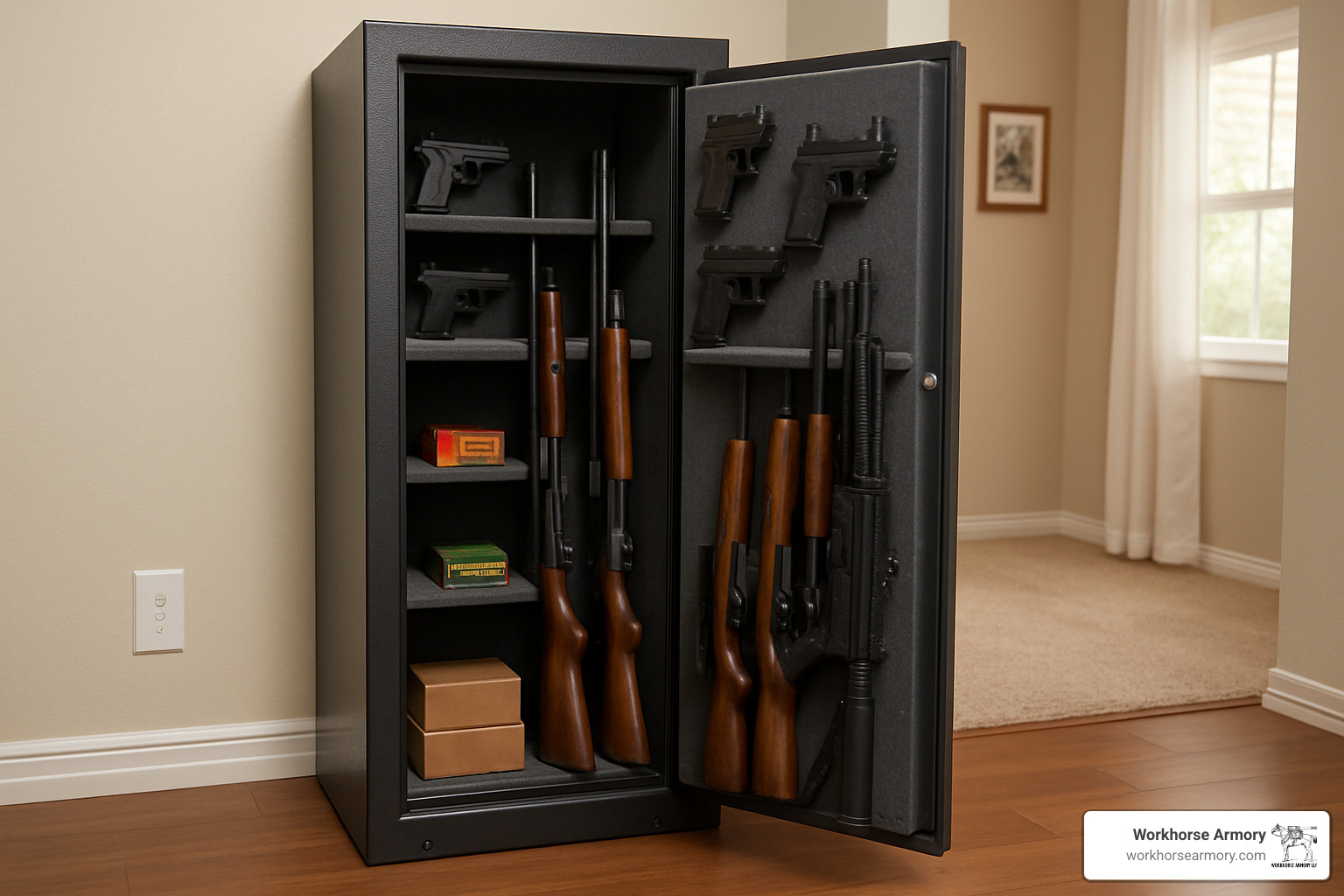
Quick-access safes work well for bedside storage if you’re keeping a firearm for home defense. Biometric or push-button locks give you fast access while keeping the gun secure.
Family education is essential if you live with others. Everyone needs to understand basic firearm safety, especially children. Teach them: don’t touch it, leave the area immediately, and tell an adult.
Building Proficiency for First-Time Gun Owner Tips
Shooting skills are perishable – they deteriorate without regular practice. Set monthly goals that challenge you without creating frustration. Keep a simple shooting journal to track progress.
Your skill development should follow logical progression. First three months: focus on safety and basic marksmanship. Months four through six: add movement and different positions. Months seven through twelve: introduce timed exercises and stress inoculation.
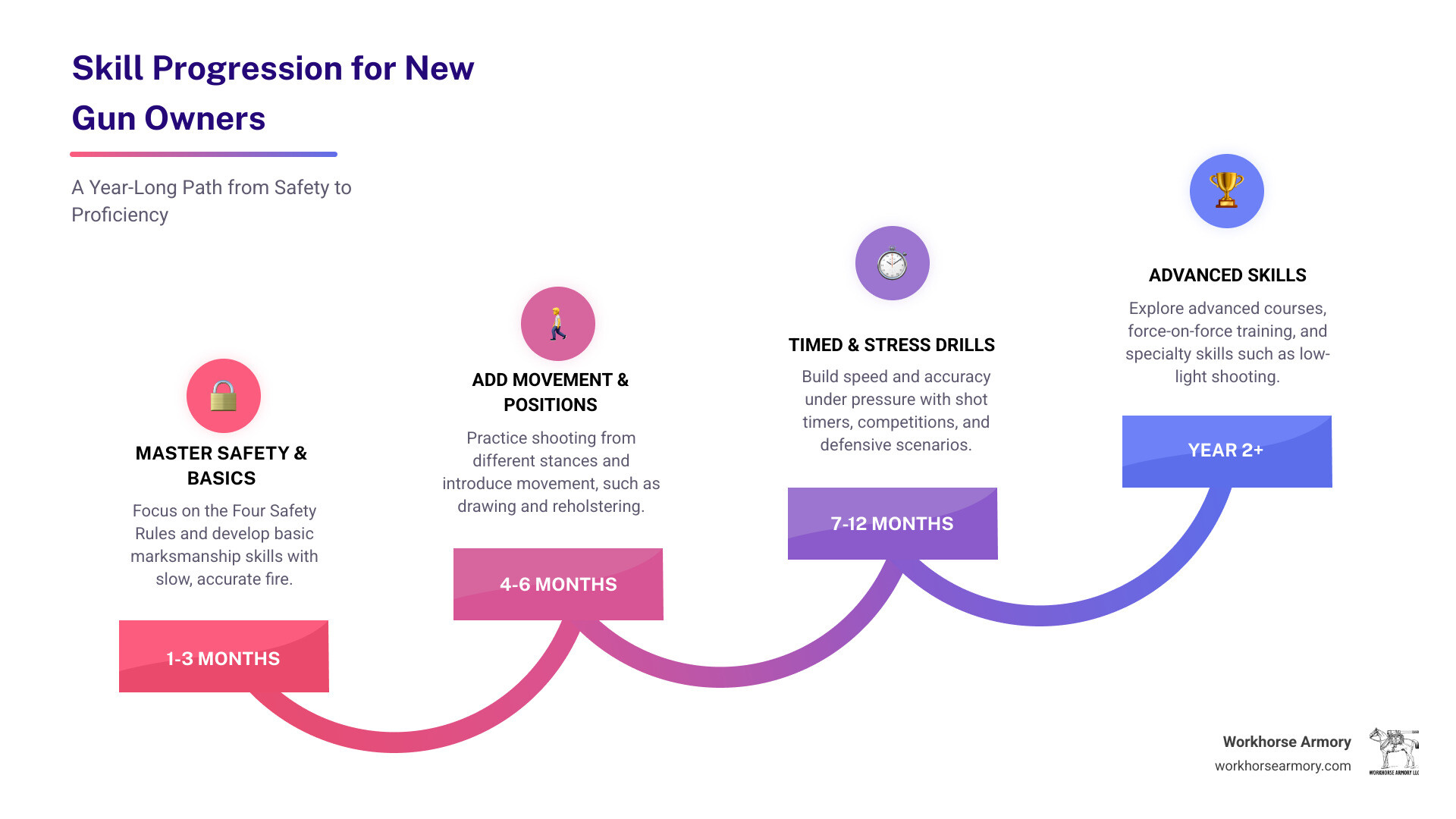
Technology can accelerate progress without breaking the bank. Shot timer apps help measure improvement objectively. Laser training cartridges allow safe practice at home with immediate feedback.
The key is consistency over intensity – regular practice sessions beat occasional marathon training days.
Best Practices for Transport to & From the Range
Case selection depends on your needs and local laws. Hard cases offer better protection and security, plus they’re required for air travel. Soft cases are lighter for regular range trips. Avoid cases that obviously scream “firearms inside.”
Always store firearms and ammunition separately during transport. Ensure firearms are completely unloaded before casing them. Lock cases when possible.
Never leave firearms visible in vehicles. Use your trunk or covered storage areas, and remove firearms promptly upon arrival. Most ranges require waivers before shooting, so arrive early for paperwork.
Frequently Asked Questions for New Owners
Let’s tackle the three questions I hear most often from new gun owners. Getting these answers right can save you money, keep your family safe, and prevent legal headaches.
How often should I clean my gun?
Clean your firearm after every shooting session, or at minimum once a month if it’s been sitting in storage. Powder residue and fouling attract moisture and cause corrosion. I’ve seen too many guns with pitting and rust damage that could have been prevented with basic maintenance. Plus, dirty guns jam more often.
The process becomes second nature quickly. Start by ensuring your firearm is completely unloaded, disassemble according to your owner’s manual, clean the barrel with appropriate solvent and patches until they come out clean, wipe down all surfaces, and apply light lubrication to moving parts.
Regular cleaning also gives you a chance to inspect for wear or damage before it becomes a problem.
What’s the safest way to store firearms with kids at home?
The statistics are sobering – approximately 4.6 million American children have access to improperly stored firearms. As a former first responder, I’ve seen the tragic results when storage fails.
All firearms must be locked in a quality gun safe or cabinet, period. No exceptions. Kids are naturally curious and surprisingly resourceful when it comes to finding things they’re not supposed to have.
Store ammunition separately and locked away from the firearms themselves. This creates multiple barriers between curious hands and potential tragedy.
For families who keep firearms for home defense, quick-access safes with biometric or push-button locks solve the speed problem while maintaining security.
Education matters too, but it’s not a substitute for proper storage. Teach your children age-appropriate gun safety, but never assume education alone is enough.
Do I need insurance or liability coverage as an owner?
While not legally required in most places, firearm insurance has become increasingly important for responsible gun owners. Even justified self-defense situations can result in expensive legal battles.
Legal defense costs alone can run $50,000 to $100,000 or more, even when you’ve done nothing wrong. Most programs cost $200-400 annually and provide millions in coverage.
Quality coverage typically includes legal defense costs, civil liability protection, and sometimes coverage for theft or damage to your firearms. Some programs provide immediate access to attorneys who specialize in self-defense cases.
Check your homeowner’s or renter’s insurance policy first – some provide limited coverage for firearms. Specialized programs through organizations like USCCA often provide more comprehensive protection designed specifically for gun owners.
Conclusion
Your journey as a gun owner is just beginning, and that’s the exciting part. The first-time gun owner tips we’ve shared here are your foundation, but the learning never really stops.
Every experienced shooter was once exactly where you are now. The difference between those who thrive and those who struggle isn’t natural talent – it’s commitment to continuous learning and practice.
The responsibility you’re taking on matters. Every time you handle your firearm safely, follow the law, and treat others with respect at the range, you’re representing millions of gun owners across the country.
Here in Albuquerque, we’ve seen thousands of new gun owners walk through our doors. The ones who succeed share common traits: they ask questions without embarrassment, they practice regularly, and they understand that confidence comes from competence, not bravado.
That’s why we built Workhorse Armory the way we did. Our veteran and first responder team knows what it’s like to depend on firearms training when it really counts. Whether you’re testing your skills on our shooting simulator, grabbing a bite at our bistro, or asking questions about storage options, we’re here because we genuinely want you to succeed.
Your path forward is clear. Start with completing legal requirements, then invest in professional training before you buy. Once you’ve tried different firearms at a rental range and made your choice, focus on secure storage and regular practice. Most importantly, stay connected with other responsible gun owners.
The single most important first-time gun owner tip we can leave you with is this: accept being a beginner. Laws change, technology evolves, and even basic skills need regular maintenance.
Welcome to a community that values safety, respects the law, and understands that with great freedom comes great responsibility. Stop by our Albuquerque location when you’re ready to take the next step – we’ll be here with expert guidance, quality gear, and probably a good story or two about our own early days as gun owners.
